A Year-Round HVAC Maintenance Calendar for Glendale
Last updated 2026-06-13. A practical calendar for Glendale's cooling-dominant Climate Zone 9.
Short version: Glendale Trane HVAC runs this maintenance rhythm on Trane systems across Glendale, CA (ZIP 91201-91208), so call (213) 772-2088 or book online to schedule. Plan on filter changes every 1-3 months, a spring cooling tune-up before the heat, and a shorter fall heating check, all tuned to Climate Zone 9 and Verdugo-foothill dust.
The essentials
- Filter: change every 1-3 months; monthly during heat and Santa Ana dust.
- Spring (Feb-Apr): cooling tune-up before the first heat wave - the key visit.
- Fall (Oct-Nov): shorter heating safety check on the furnace.
- Climate Zone 9: 35-50 days a year above 90 F; long cooling season.
- Verdugo-foothill dust and pollen foul coils and filters faster than the coast.
- The run capacitor is the part to catch early - a planned $150-$450 fix.
- Documented visits support Trane warranty claims on major parts.
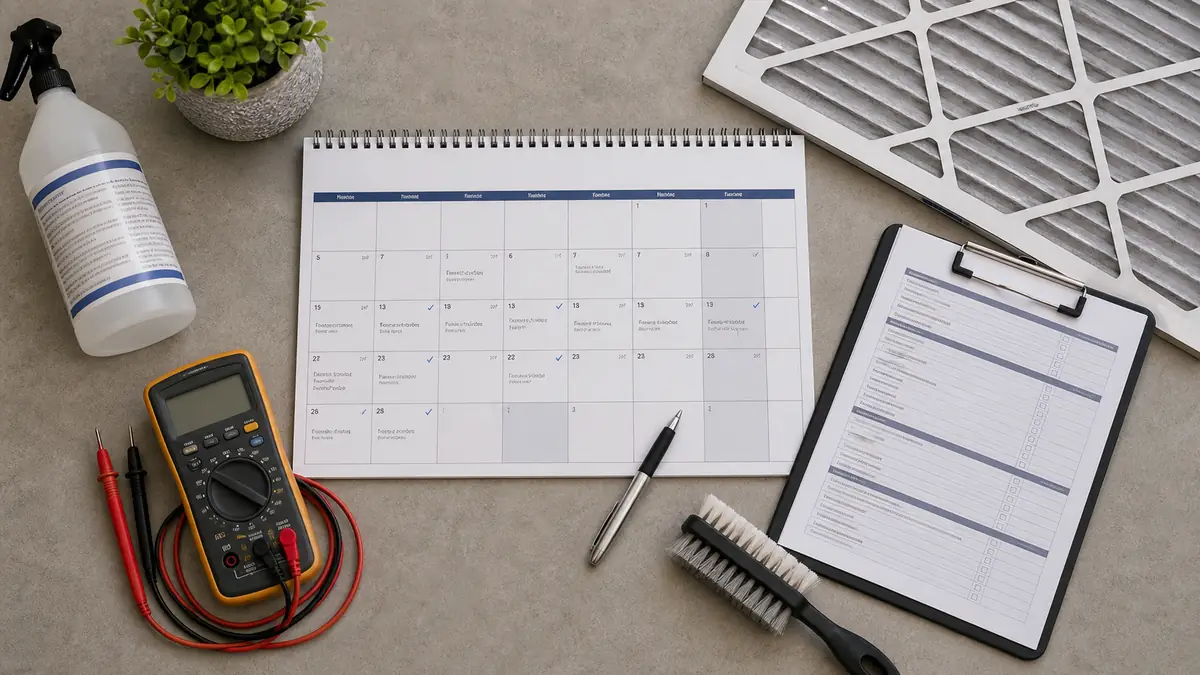
Why does Glendale need its own maintenance rhythm?
Generic "service your AC once a year" advice undersells what a cooling-dominant climate demands. Glendale sits in Title-24 Climate Zone 9 and runs 35 to 50 days a year at or above 90 F, with foothill pockets in Glenoaks Canyon and El Miradero that hold heat into the evening - so the cooling system works hard for a long season. Just as important, the fine dust and pollen blowing off the Verdugo Mountains, plus Santa Ana wind events, load filters and coat coils faster than a coastal city would. That combination means the highest-value maintenance is front-loaded into spring, with filter discipline all summer, and a lighter touch on the short heating season.
What's the month-by-month plan?
You do not need to do something every month, but a few moments matter. Here is the practical calendar we recommend for a Glendale home, blending homeowner tasks with the two professional visits.
| Window | Task | Who |
|---|---|---|
| Feb - Apr | Cooling tune-up: capacitor, contactor, coil wash, charge, drain | Pro (key visit) |
| Monthly, May - Oct | Check and change filter; rinse condenser coil; clear 2 ft around the unit | You |
| Jun - Sep | Watch for weak cooling, odd noises, rising bills; call early | You |
| After Santa Ana events | Inspect and likely change filter; hose dust off the coil | You |
| Oct - Nov | Heating safety check: flame sensor, pressure switch, limit, heat exchanger | Pro |
| Dec - Jan | Confirm thermostat schedule; keep condensate area clear | You |
What does the spring cooling visit cover?
This is the visit that prevents July emergencies, so it is thorough. We read capacitance on the dual-run capacitor against its rating - the part most likely to strand you in the heat - and inspect the contactor points. We clear and test the condensate drain and float switch, because a clogged drain in summer shuts the system off or floods the air handler. We wash the Spine Fin condenser coil and the evaporator if accessible, measure refrigerant charge via superheat and subcooling, and read airflow and static pressure. On a communicating XV system we pull any stored alerts off the XL824 or XL850. The goal is to find the one part trending toward failure while it is still a scheduled repair.
What does the fall heating check cover?
Glendale's heating season is short and mild, so this visit is leaner - but the items on it are safety items, which is why we do not skip it. We inspect and clean the hot-surface igniter and flame sensor, check the inducer and pressure switch, verify the high-limit, and look over the heat exchanger for any sign of cracking. A furnace that sat idle through a hot summer sometimes develops a fault that only shows on the first cold-morning call, so testing it in October beats discovering it in January. We read any furnace flash codes and confirm the thermostat changeover works.
How does maintenance differ across Glendale neighborhoods?
The plan flexes by location. Foothill homes in Glenoaks Canyon and El Miradero collect more dust and run their cooling longer, so coil cleaning and capacitor checks matter most there, and filters may need changing monthly in peak season. Dense flatland homes in Rossmoyne and Adams Hill more often have airflow problems from undersized 1920s returns, so we watch static pressure and the furnace high-limit closely - a clogged filter in one of these homes trips a 4-flash limit fast. We tune the visit to your home rather than running an identical checklist citywide. Our maintenance plans page covers how the two-visit schedule works, and our high energy bills page shows what neglected maintenance costs.
Season by season: what to do and when
If the table is the summary, here is the reasoning behind each block of the Zone-9 year - why the task lands in that window and what it prevents.
Late winter to spring (February-April). This is the high-value stretch. Cooling demand has not started, techs are not slammed, and any weak part found now is a scheduled repair instead of a July breakdown. Book the cooling tune-up here. A dual-run capacitor reading below about 90 percent of its rated microfarads gets replaced now for $150-$450 rather than after it strands you at 95 F. It is also the right time to wash a winter's worth of debris off the Spine Fin coil and confirm the condensate drain is clear before the season that actually produces condensate.
Early summer (May-June). Start monthly filter checks and keep two feet of clearance around the condenser. In Glendale's foothill pockets the cooling season is long, so a filter that lasted three months in spring may need monthly changes once the unit runs daily. This is also when a borderline system first reveals itself - if cooling feels weak on the first 90 F day, call early, before the heat-wave rush stacks up service calls.
Peak summer (July-September). Run-time is at its maximum and so is stress on the capacitor, contactor, and compressor. Stay on the monthly filter rhythm, hose Verdugo dust off the condenser coil with the power off, and watch the three early-warning signs: weak cooling, new noises, and a climbing bill. Each points to a developing fault that is cheaper to fix the week it starts than the day the system quits. After any Santa Ana wind event, inspect the filter immediately - those events load it fast.
Fall (October-November). Book the shorter heating safety check before you rely on the furnace. Even a few hours of heating a week is enough that a flame sensor, pressure switch, or high-limit problem matters. A furnace that idled all summer sometimes develops a fault that only appears on the first cold-morning call, so testing in October beats a January surprise.
Winter (December-January). The lightest block. Confirm the thermostat schedule, keep the condensate area clear, and keep changing filters on the normal cadence even though run-time is low. On a communicating XV system, glance at the XL824 or XL850 for any stored alert you may have missed.
What can you do yourself, and what needs a tech?
A clear line keeps you safe and keeps the warranty intact. The homeowner side is the high-frequency, low-risk work: change the filter on schedule, keep two feet of clearance around the outdoor unit, gently rinse Verdugo dust and leaves off the Spine Fin coil with a garden hose while the power is off at the disconnect, and keep the area around the condensate drain clear so a summer clog is obvious early. None of that needs tools beyond a hose and a fresh filter.
The pro side is anything involving refrigerant, electricity, or combustion, because each needs instruments and training the law and the warranty assume. Reading capacitance against a capacitor's rated microfarads needs a meter. Checking charge by superheat and subcooling needs gauges. Inspecting a flame sensor, pressure switch, high-limit, and heat exchanger on the furnace is combustion-safety work. Pulling stored alerts off an XL824 or XL850 and interpreting a ComfortLink II fault is diagnostic work. Doing these yourself risks an injury, a voided Trane parts warranty, or a misdiagnosis that costs more than the visit. The split is simple: you handle airflow and cleanliness, we handle anything measured in pressures, volts, or flue gases.
| Task | Who | Why |
|---|---|---|
| Filter change, coil rinse, clearance | You | No tools, low risk, high frequency |
| Capacitor / contactor check | Tech | Needs a meter; electrical |
| Refrigerant charge by superheat/subcooling | Tech | Gauges; EPA-regulated refrigerant |
| Furnace combustion safety items | Tech | Flame, flue, heat exchanger safety |
| Reading ComfortLink II alerts | Tech | Diagnostic interpretation |
What does skipping maintenance actually cost?
Neglect does not break a system overnight; it raises the floor on everything. A dirty coil and a tired capacitor each make the compressor work harder, which shows up first as a higher bill and eventually as a shortened compressor life - and a compressor is a $1,200-$3,500 part, versus the $150-$450 capacitor that should have caught it. A clogged condensate drain that nobody cleared in spring backs up in July and either shuts the system off on its float switch or overflows into the air handler. A choked filter trips the furnace high-limit (the 4-flash code) and, repeated over seasons, is the kind of chronic overheating that cracks heat exchangers. None of these are dramatic; all of them are cheaper to prevent than to repair in season. That is the entire economic case for the spring-and-fall rhythm.
Does keeping up maintenance protect my warranty?
It helps materially. Trane's registered parts warranties expect the system to be reasonably maintained, and documented annual service supports a claim if a major component fails. We log model numbers, measurements, and the work performed at each visit, so if a compressor or coil fault sends you to a Trane-authorized dealer, you have the maintenance record they may ask for. That paper trail is one more reason the spring-and-fall rhythm earns its keep - see our background page for how we handle warranty referrals.
Common questions
How often should I change my filter in Glendale?
Every one to three months, and toward the one-month end during the long cooling season and Santa Ana dust events. Glendale's fine Verdugo-foothill dust and pollen load filters faster than a milder coastal area. A choked filter starves airflow, raises bills, and can trip a furnace high-limit (the 4-flash code).
When is the best time to book a cooling tune-up?
Late winter into early spring - February through April - before the first heat wave. That is when we can catch a weak capacitor or low charge as a planned repair instead of a July no-cool emergency. Booking in May or June competes with everyone else who waited until their AC struggled.
Do I really need a fall heating check in such a mild climate?
A shorter one, yes. Glendale winters are mild, so the furnace runs few hours, but the safety items - flame sensor, pressure switch, heat exchanger, high-limit - still need a look before you rely on it. A quick fall check also catches a furnace that sat unused all summer and developed a fault.
What can I safely do myself between visits?
Change the filter on schedule, keep two feet of clearance around the outdoor condenser, gently rinse leaves and Verdugo dust off the Spine Fin coil with a hose (power off), and keep the condensate drain area clear. Leave refrigerant, electrical, and combustion work to a tech - those need gauges, meters, and training.