Trane HVAC Maintenance Plans in Glendale
Short version: Call Glendale Trane HVAC at (213) 772-2088 or book online for spring and fall Trane maintenance across Glendale, CA - from Rossmoyne (91206) to Verdugo Woodlands (91208). We test capacitors, clear condensate drains, wash the Spine Fin coil, and verify charge before the heat hits; an off-plan diagnostic visit runs $79 to $200.
The essentials
- Two visits a year: spring cooling tune-up, fall heating check.
- Each visit tests the run capacitor - the most common SoCal AC failure.
- Includes condensate drain clearing, coil wash, charge check, airflow read.
- Tuned to Zone 9 dust, foothill pollen, and 35-50 days a year above 90 F.
- Documented model numbers and measurements support Trane warranty claims.
- Plan pricing varies by system - ask when you book; diagnostic visits $79 to $200 if not on plan.
- Covers Trane XR, XL, XV systems and S-series furnaces across 91201-91208.
Why does Glendale need twice-a-year service?
Climate Zone 9 is cooling-dominant, and the city runs 35 to 50 days a year at or above 90 F, with foothill pockets that hold heat into the evening. That load works the cooling system hard for months. The fine dust and pollen off the Verdugo Mountains load up filters and coat the evaporator and Spine Fin condenser coil faster than a coastal climate would, which chokes airflow and raises head pressure. A spring tune-up before the first heat wave is the highest-value visit of the year; the fall check keeps the furnace honest for the short, mild heating season.
What's on the spring and fall checklist?
The spring cooling visit targets the parts that strand people in July: capacitance on the dual-run capacitor, contactor point condition, a cleared condensate drain and a tested float switch, a washed Spine Fin coil, measured refrigerant charge via superheat and subcooling, and an airflow read. The fall heating visit covers the furnace side: hot-surface igniter and flame sensor, inducer and pressure switch, the high-limit, and the heat exchanger. On ComfortLink II systems we pull any stored alerts off the XL824 or XL850.
| Season | Key checks | What it prevents |
|---|---|---|
| Spring (cooling) | Capacitor, contactor, coil wash, charge, drain | July no-cool emergencies |
| Fall (heating) | Igniter, flame sensor, pressure switch, limit | Cold-morning furnace lockouts |
| Either visit | Filter, airflow, thermostat, stored fault codes | High bills, high-limit trips |
How does a maintenance visit run, step by step?
The spring cooling tune-up follows a set order so nothing gets skipped.
- Readings before cleaning. We record capacitance, contactor condition, compressor and fan amp draw, and the supply-air temperature split so we can see how the system performed against last year's log.
- Airflow and filter. Replace or clean the filter, check static pressure, and confirm the return is not choking a high-efficiency coil - the airflow problem behind most 4-flash high-limit trips.
- Drain and float. Clear the condensate drain and test the float switch so a summer clog does not shut the AC off mid-heat-wave.
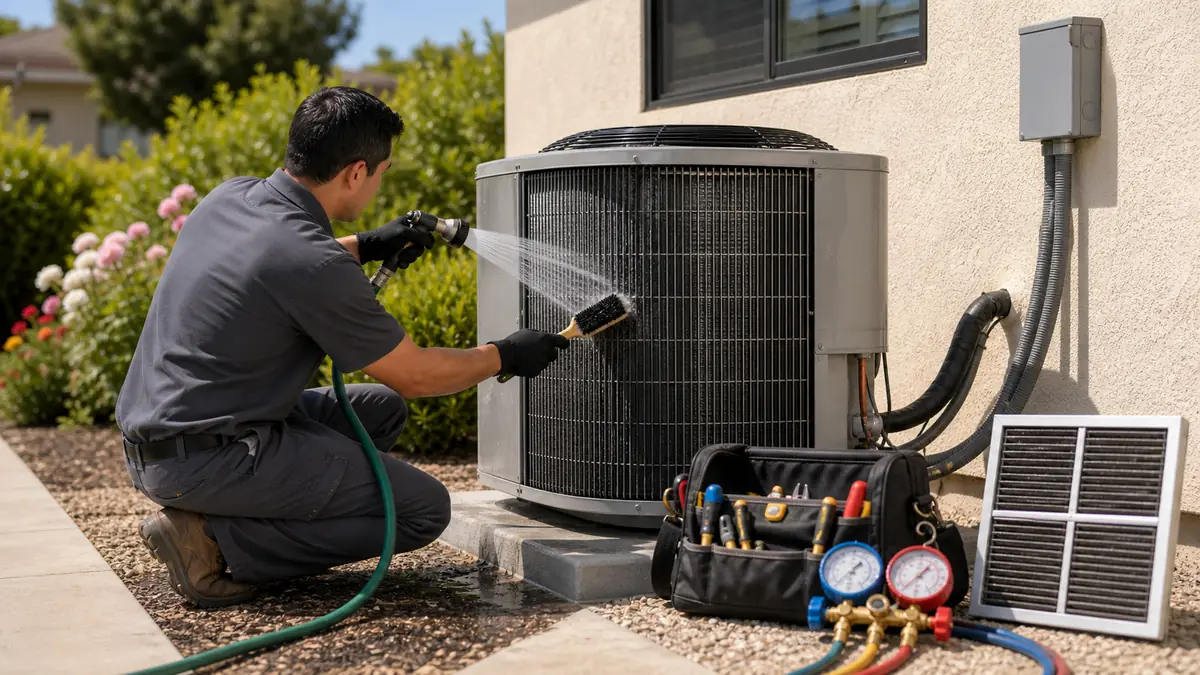
- Coil wash. Rinse the all-aluminum Spine Fin condenser coil to shed the Verdugo dust and pollen that raise head pressure and run the compressor hot.
- Charge and document. Verify refrigerant charge by superheat and subcooling, then log the model numbers, readings, and any flagged parts for your record and any future warranty claim.
What does maintenance cost, and does it pay off?
Plan pricing depends on your system and how many visits you set up, so ask when you book; an off-plan one-time tune-up or diagnostic visit lands in the normal $79 to $200 SoCal band. The math favors the spring visit because it converts emergencies into planned fixes: a weak capacitor caught reading low in April is a routine $200 part, while the same capacitor failing during a 95 F Verdugo heat spike becomes an urgent no-cool call with a hotter house and a tighter schedule. Maintenance also protects the SEER2 efficiency you paid for - a fouled coil and low charge quietly add to every July bill until someone cleans and corrects them.
How does maintenance change by neighborhood?
The foothill homes in Glenoaks Canyon and El Miradero get dustier and run their cooling longer, so coil cleaning and capacitor checks matter more there. Dense flatland homes in Rossmoyne and Adams Hill more often have airflow problems from undersized 1920s returns and clogged filters, so we watch static pressure and the furnace high-limit closely. Homes near the Verdugo Wash and Verdugo Woodlands collect more wind-blown grit on the condenser, which is why the coil wash carries extra weight there. We tailor the visit to your home rather than running an identical checklist on every Glendale address, and we keep the prior year's readings on file so a slow drift - a capacitor losing microfarads season over season, a charge creeping low - gets caught before it becomes a failure.
When is a plan not worth it?
We will tell you. On a healthy 8- to 12-year-old Trane, regular service genuinely extends life and protects the SEER2 efficiency you paid for. On a 17-year-old unit that is one failure away from replacement, a multi-year plan mostly delays a decision - we would rather walk you through the repair-versus-replace math and, if it is time, point you at the right Trane on our buying guide. Honest advice keeps you as a customer longer than a plan you do not need.
Common questions
How often should a Trane system be serviced in Glendale?
Twice a year fits Glendale's climate: a spring cooling tune-up before the first heat wave and a fall heating check before the furnace season. The cooling-dominant Zone 9 load and the fine dust off the Verdugo foothills clog coils and filters faster than a milder coastal climate, so the spring visit matters most.
What does a maintenance visit actually catch?
The failures that strand you in July. We read capacitance on the run capacitor (the part that fails most), inspect the contactor points, clear the condensate drain and check the float switch, wash the Spine Fin coil, measure refrigerant charge, and read airflow. A weak capacitor caught in spring is a planned $200 part, not a 98 F emergency.
Does maintenance keep my Trane warranty valid?
It helps. Trane's registered warranties expect the system to be properly maintained, and documented annual service supports a claim if a major part fails. We log model numbers, measurements, and the work done each visit so you have the paper trail an authorized dealer or Trane may ask for.
Is a maintenance plan worth it on an older system?
Often, yes - up to a point. On a sound 8- to 12-year-old Trane, tune-ups extend its life and protect efficiency. On a 17-year-old unit nearing replacement, we will tell you honestly that a plan is just delaying the inevitable, and point you toward repair-versus-replace math instead of selling you years of visits.
Will a tune-up actually lower my Glendale energy bill?
It can, by restoring lost efficiency rather than adding any. A coil caked with Verdugo dust, a low refrigerant charge, and a choked filter all force the compressor to run longer for the same cooling. Washing the Spine Fin coil, correcting the charge to the right superheat and subcooling, and clearing airflow brings the system back to its rated SEER2, which shows up on a July bill.
How long does a maintenance visit take?
A standard spring or fall visit runs about one to one and a half hours for a single Trane system in good condition. Foothill homes in Glenoaks Canyon with heavier coil fouling, or homes with a second system, take longer. If the visit turns up a failing part - a weak capacitor reading low on microfarads, for example - we quote the repair separately and you decide on the spot.
Do I have to be a plan member, or can I book a one-time tune-up?
Either works. You can book a single spring or fall tune-up without committing to a plan, or set up recurring visits so we reach out before each season. Plan pricing depends on your system and visit count, so ask when you book; a one-off diagnostic or tune-up visit falls in the normal $79 to $200 SoCal band. We log your model numbers and readings each time regardless.