SEER2 Rules and California Rebates for Glendale Homes
Last updated 2026-06-13. Rebate amounts change in funding phases - verify current figures on each program's official page before budgeting.
Short version: Glendale Trane HVAC installs to current SEER2 and Title-24 rules across Glendale, CA (ZIP 91201-91208), so call (213) 772-2088 or book online for a code-compliant quote. The Southwest-region floor is roughly 14 SEER2 on a small split AC; the federal 25C credit closed at the end of 2025, while some California utility rebates may still pay out.
The essentials
- The SEER2/EER2/HSPF2 test took effect January 1, 2023, using a tougher static-pressure setup that reads closer to a real duct system.
- Split AC under 45,000 BTU: 14.3 SEER2 / 11.7 EER2 (Southwest region).
- Split AC at or above 45,000 BTU: 13.8 SEER2 / 11.2 EER2.
- Split air-source heat pump: 14.3 SEER2 with 7.5 HSPF2 (national floor).
- Glendale lands in Title-24 Climate Zone 9; HERS field verification is standard on charge and duct work.
- The federal 25C heat-pump credit was REPEALED at 12/31/2025 - zero for 2026 installs.
- LADWP-area, SCE, SoCalGas, and TECH programs may still be live - confirm current status first.
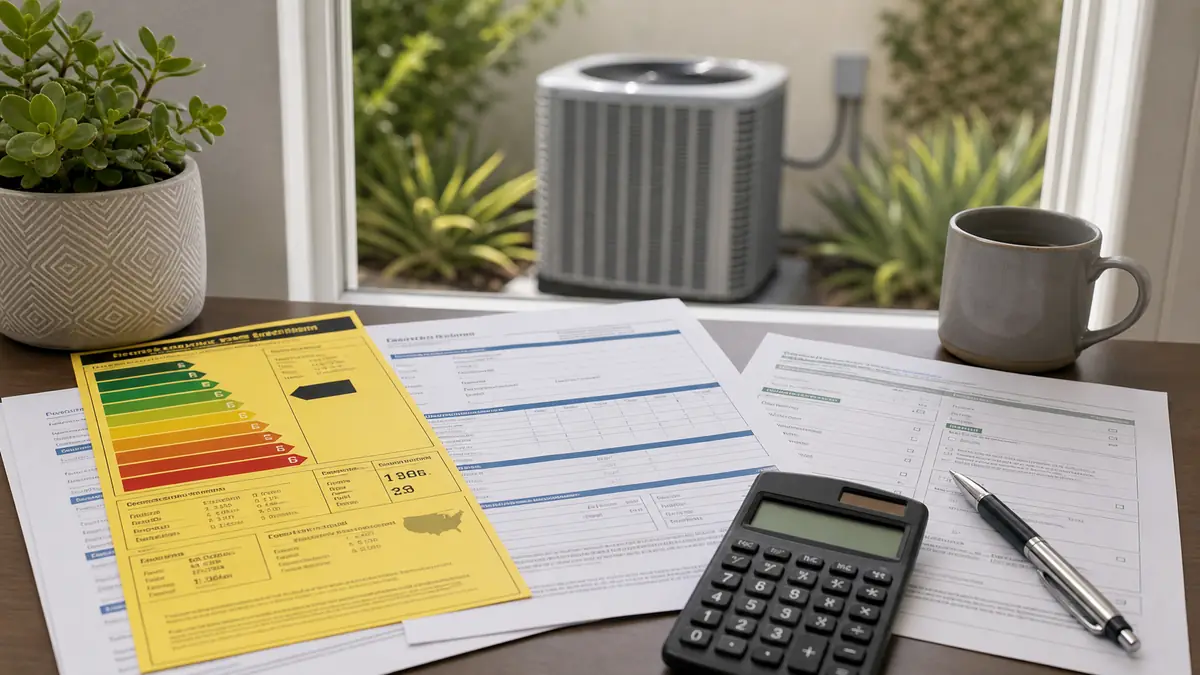
What does SEER2 actually mean for a Glendale install?
SEER2 replaced the old SEER figure on January 1, 2023. The "2" marks a harder bench test. Ratings now run against higher external static pressure, the kind a real ducted house imposes, so a given unit reads slightly lower under SEER2 than it once did under SEER. The hardware did not regress; the test got honest. California's heavy cooling load puts it in the DOE Southwest region, the toughest cooling tier in the country. For a Glendale owner the consequence is simple. Every new central system has to beat a real floor, and in a cooling-dominant climate, paying for headroom above that floor returns faster than it would near the coast.
| Equipment | Minimum | Notes |
|---|---|---|
| Split AC, under 45,000 BTU | 14.3 SEER2 / 11.7 EER2 | Most Glendale homes |
| Split AC, 45,000 BTU and up | 13.8 SEER2 / 11.2 EER2 | Larger homes |
| Split air-source heat pump | 14.3 SEER2 / 7.5 HSPF2 | National minimum |
| Trane XR value tier | Meets minimum | Single-stage workhorse |
| Trane XV20i top tier | Up to ~20.5 SEER2 | Variable-speed |
How does Title-24 apply in Glendale's Climate Zone 9?
The federal equipment floors set the minimum hardware; California's Title-24, Part 6 energy code governs how it goes in. Title-24 splits the state into 16 climate zones tied to reference weather stations, not city limits, and almost all of Glendale falls in cooling-dominant Climate Zone 9. In this zone, a new or replacement split system usually requires refrigerant-charge and airflow verification, and any work that alters or swaps ductwork generally triggers duct-leakage testing with HERS field verification by an independent third-party rater. The code has also drifted toward heat-pump-ready and heat-pump-preferred baselines. The changeout itself needs a City of Glendale mechanical permit. We pull the permit and schedule the HERS rater so the job passes inspection.
Stated plainly: the code cycles shift. The 2022 energy code started January 1, 2023, and a 2025 cycle has followed. The exact SEER2/HSPF2 thresholds, the HERS triggers, and the governing cycle all hinge on your equipment class and your address, so they get pinned down before anyone claims firm compliance. We verify rather than guess.
Which rebates can a Glendale homeowner realistically use?
On this topic, candor beats a headline number, because the incentive landscape flipped hard at the end of 2025. The headline change: the federal 25C tax credit - 30 percent of project cost, capped at $2,000 for heat pumps - was repealed effective December 31, 2025. Only gear purchased and installed on or before that date remains claimable, and only on the 2025 return. A 2026 install draws no federal 25C credit whatsoever. Any contractor still waving it around is quoting stale rules.
State and utility programs are real, but they run in funding phases, and several were reported fully reserved or paused in early 2026. Treat every dollar figure below as "reported - confirm it before you rely on it."
| Program | Reported amount | Caveat |
|---|---|---|
| Federal 25C credit | Was 30% up to $2,000 | REPEALED 12/31/2025 - none for 2026 |
| LADWP-area heat-pump rebate | Up to ~$2,500 per ton | Tiered by efficiency; verify per-ton and eligibility |
| SCE heat-pump HVAC | ~$1,000 per system | Up to 2 systems; verify status |
| SoCalGas high-efficiency furnace | Up to ~$600 | Min ~92% AFUE; changes by program year |
| TECH Clean California | ~$1,000-$1,500 market-rate | Single-family funds reported reserved early 2026 |
One note on programs that do NOT reach Glendale: BayREN Home+ serves the nine-county San Francisco Bay Area, not LA, and 3C-REN operates only in Ventura, Santa Barbara, and San Luis Obispo counties. Glendale is a Los Angeles County address, so neither one applies here, no matter how a generic rebate roundup bundles them. We point it out so you do not chase money you cannot actually collect.
How do you actually claim a utility rebate?
The mechanics matter as much as the dollar figure, because a rebate you qualify for on paper is worthless if you miss a step. Confirm which utility serves your specific Glendale address first - electric service determines the electrification rebate, and that decides whether you are looking at an LADWP-area program or SCE, while SoCalGas governs the furnace side. Check eligibility before you buy, since most programs require the equipment to meet a stated efficiency tier and, often, pre-approval or enrollment before installation. Keep every document: the AHRI certificate matching your exact outdoor and indoor models, the paid invoice, the permit, and the HERS verification report, because programs routinely ask for them. Apply within the program's window after install. And treat the published amount as provisional - several California programs were reported fully reserved or paused in early 2026, so pull the live figure and funding status off the official page before you count a single dollar of it toward your budget.
Does a higher SEER2 Trane pay off in Glendale?
It depends on the starting point and the home. Replacing a 15-plus-year-old unit running at an old, low rating during Glendale's long cooling season can produce real savings, and a variable-speed XV18 or XV20i that modulates instead of cycling full-on stretches that further - particularly in larger or sun-exposed foothill homes. But the efficiency you buy only materializes if the rest of the system supports it: correct refrigerant charge, clean coils, and tight, properly sized ducts. A 20-SEER2 condenser pushing air through leaky 1920s ductwork will never hit its rating. We sequence the work - charge, airflow, ducts, then equipment - so your money goes to the changes that actually lower the bill.
A worked example: what higher SEER2 saves in Glendale
Run the math on a real-ish case. Say a Rossmoyne home cools with an old 10-SEER 4-ton unit and spends about $1,200 a year on cooling during Glendale's long Zone-9 season. Efficiency savings scale roughly with the ratio of the old rating to the new one. Replace it with a code-minimum 14.3 SEER2 system and annual cooling energy drops by something like a third - on the order of $350-$450 a year, all else equal. Step up to a variable-speed XV20i near 20.5 SEER2 and the modeled drop approaches half, perhaps $500-$600 a year, with the modulation also smoothing out the temperature swings a big revival home suffers. Those are estimates, not promises - actual savings hinge on charge, duct tightness, and how you run the thermostat. But the direction is clear: in a cooling-dominant climate the efficiency step pays back faster than it would on the coast, and the variable-speed premium makes the most sense on a large or sun-exposed home, not a small flatland one.
| System | Rating | Modeled annual cooling cost |
|---|---|---|
| Existing old unit | ~10 SEER | ~$1,200 baseline |
| Code-minimum replacement | 14.3 SEER2 | ~$800 (about a third less) |
| Two-stage mid-tier | ~17 SEER2 | ~$700 |
| Variable-speed XV20i | ~20.5 SEER2 | ~$650 (about half off) |
What does HERS verification add to the job?
In Climate Zone 9, the parts of Title-24 you will actually feel are the field-verification steps. A new or replacement split system generally requires refrigerant-charge and airflow verification, and any duct alteration or replacement triggers a duct-leakage test, both signed off by an independent third-party HERS rater - not the installer. That independence is the point: the rater confirms the charge is right and the ducts are not bleeding the efficiency you paid for. Budget for the rater's fee as a real line item, and expect the changeout itself to need a City of Glendale mechanical permit. A contractor who skips the permit or the HERS sign-off is leaving you with a job that can fail inspection at resale. We pull the permit and schedule the rater as part of the install, so compliance is handled rather than discovered later.
How do I decide without overpaying?
Match the tier to the house, not the brochure. A flatland Glendale home with a simple load is well served by a code-minimum to mid-tier single- or two-stage Trane. A large Rossmoyne revival, or a heat-trapping El Miradero foothill house, draws more value from variable-speed. Treat any rebate as a bonus you get in writing from the program, never a number we promise. And nail the load calculation first. A Manual J sizing settles it, because nothing wastes more money than an oversized high-SEER2 unit that short-cycles. Our Trane buying guide for Glendale walks the tiers, and our AC installation page covers sizing and permitting.
Common questions
What's the minimum SEER2 I can install in Glendale right now?
Glendale sits inside the DOE Southwest region. That region carries the country's stiffest cooling floors. For a split central AC under 45,000 BTU, the bar is 14.3 SEER2 / 11.7 EER2. Cross 45,000 BTU and it eases to 13.8 SEER2 / 11.2 EER2. A split air-source heat pump owes both 14.3 SEER2 and 7.5 HSPF2. No Trane we put in lands under those marks.
Is the federal heat-pump tax credit still available in 2026?
No. The federal 25C Energy Efficient Home Improvement Credit closed on December 31, 2025. One narrow path remains: the equipment had to be purchased and installed on or before that date, and the claim rides on the 2025 return you file in 2026. Install in 2026 and 25C pays nothing. Keep it out of the budget. Check it against current IRS guidance.
Which California rebates might actually apply in Glendale?
Your utility decides. In the LADWP service area, heat-pump incentives have been cited near $2,500 per ton. SCE has offered roughly $1,000 toward a qualifying heat-pump HVAC system. SoCalGas has gone up to about $600 on a qualifying high-efficiency furnace. Each figure moves with the funding round, so pull the live number off the program's own page before you count on it.
Why do you keep saying 'verify the amount'?
These programs run in rounds. Several were reported fully reserved or paused in early 2026. Last quarter's figure can already be spent, waitlisted, or rewritten. So we quote the equipment plainly and point you to the official program page rather than promise a rebate dollar amount that may have lapsed.