Trane Furnace Repair in Glendale
Short version: Call Glendale Trane HVAC at (213) 772-2088 or book online for Trane furnace repair across Glendale, CA - Rossmoyne, Adams Hill, Verdugo Woodlands, Glenoaks Canyon, and all 91201-91208 ZIPs. We read Trane furnace flash codes first, then diagnose igniters, flame sensors, pressure switches, high-limit trips, and gas-valve faults before quoting a repair.
The essentials
- Repairs Trane S-series, XR80, XL80, XV80, S9V2, XV95, and XC95m gas furnaces.
- Common Glendale no-heat parts: hot-surface igniter, flame sensor, pressure switch, inducer, high-limit, and gas valve.
- Flash-code lane: 2 ignition lockout, 3 pressure switch, 4 high-limit, 7 gas valve, 8 flame sense, 9 igniter circuit.
- Typical 2026 SoCal repair lanes: sensor or igniter $120 to $500; inducer or pressure-switch work $200 to $900.
- Cracked heat exchanger or rollout condition means shut down and replace, not patch.
- Service area: Glendale 91201-91208, including Rossmoyne, Adams Hill, El Miradero, and Verdugo Woodlands.
- Independent shop; in-warranty Trane parts go to authorized service first.
- Hours: Open daily 7am-9pm.
What usually fails on a Trane furnace in Glendale?
Glendale is not a heavy heating market, which is exactly why furnace failures show up suddenly. A Trane furnace can sit almost unused through spring, summer, and fall, then fail the first week a hillside home in 91206 or 91208 actually needs heat. The parts that age while idle are predictable: the hot-surface igniter develops a hairline crack, the flame sensor oxidizes and cannot prove flame, the pressure switch sticks, or a dirty filter starves airflow until the high-limit opens.
Older Spanish-revival homes in Rossmoyne and Adams Hill add the duct side of the problem. Undersized returns and old filters make the furnace run hot, so the board flashes a high-limit code even though the burner and gas valve are fine. We test airflow and static pressure instead of just replacing ignition parts.
| Symptom / flash code | Likely cause / first check | Cost lane |
|---|---|---|
| 2 flashes, repeated tries | Ignition lockout; igniter, gas, flame sensor | $150 - $700 |
| 3 flashes | Pressure switch, inducer draft, flue restriction | $200 - $900 |
| 4 flashes | Open high-limit; dirty filter, blocked return, blower issue | $120 - $700 |
| 7 flashes | Gas valve circuit or wiring fault | $200 - $900 |
| 8 flashes | Weak flame-sense signal; clean or replace sensor | $120 - $350 |
| 9 flashes | Igniter circuit or grounding issue | $150 - $500 |
| Rollout trip or flame rollout | Heat exchanger or venting safety fault | Shut down; inspect before relight |
How does a furnace repair visit work?
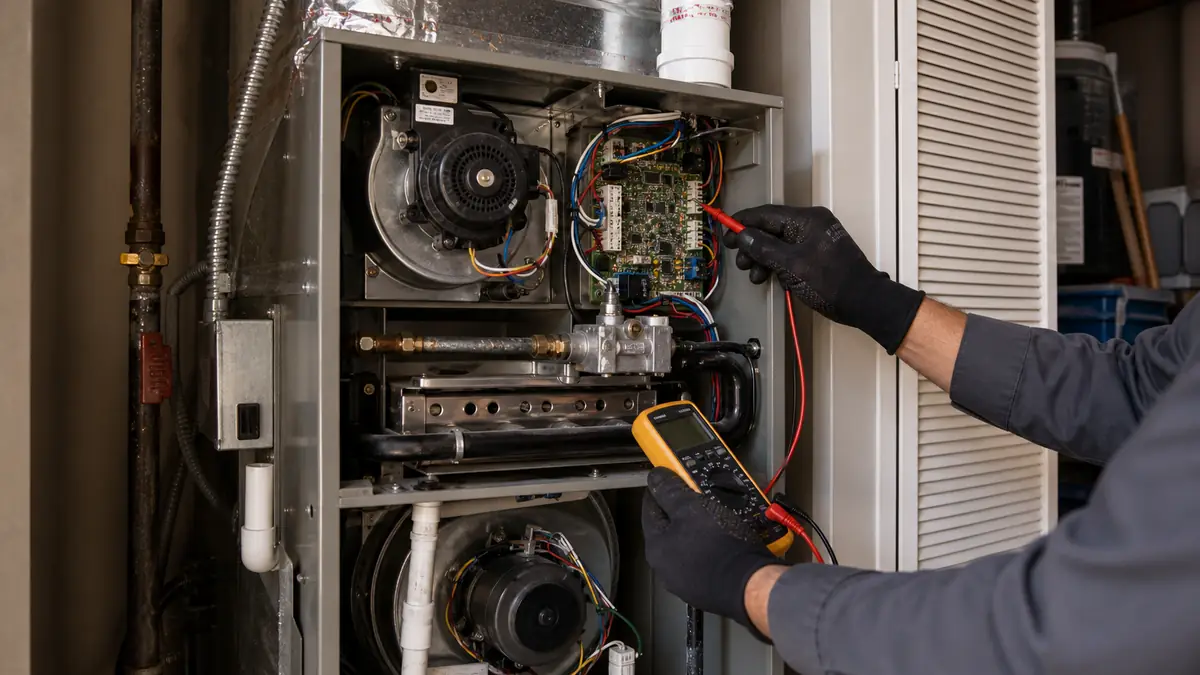
A furnace diagnosis follows the ignition sequence. First we read and record the flash code on the integrated furnace control. Then we confirm the call for heat, verify line voltage and 24V control voltage, watch the inducer start, and prove whether the pressure switch closes. From there we meter the hot-surface igniter, check gas-valve energizing, clean or test the flame sensor by microamp signal, and confirm the high-limit and rollout safeties are closed.
That order matters. A 4-flash high-limit code is often airflow, not a bad board. A 3-flash pressure code can be a blocked flue, a cracked inducer hose, or a weak inducer motor. A furnace that lights for three seconds and drops flame usually needs flame-sense work, not a new gas valve. We name the part only after the readings point at it.
What makes Glendale furnace calls different?
Glendale furnace work is less about extreme winter load and more about age, airflow, and access. Rossmoyne and Adams Hill homes often have older return paths and smaller closets, so a high-limit trip may be a duct and filter problem instead of a failed furnace control. Verdugo Woodlands and Glenoaks Canyon homes can have hillside utility rooms or attic platforms where venting, condensate routing, and service access change the labor. We look at the furnace as part of the whole air path, not as an isolated box.
That matters because a Trane furnace shares the blower with the cooling system. A weak ECM blower can show up as a 4-flash heating limit in January and a frozen coil or poor supply-air split in July. A homeowner may call it "furnace repair," but the metered fault may connect to the same airflow problem covered on the Trane AC repair page. If the equipment is old enough that both heating and cooling are affected, we price the narrow repair and the broader replacement path side by side.
We also keep safety separate from ordinary repair. An igniter, flame sensor, pressure switch, or inducer is a normal service ticket. A rollout switch trip, flame rollout, soot, repeated burner disturbance, or heat-exchanger concern is not. In those cases the furnace stays off until the venting and combustion side is inspected. That is slower than swapping a part, but it is the line that keeps a no-heat call from becoming a carbon-monoxide problem.
What should you note before calling?
If the furnace has a flash-code window, count the flashes before turning power off. Two, three, four, seven, eight, or nine flashes each point the diagnosis toward a different part of the Trane sequence, and some boards clear the code after a reset. Also note whether the inducer starts, whether the igniter glows, whether the burners light for a few seconds, and whether the blower starts before or after the lockout. Those observations are enough to narrow the visit without asking you to open the gas train.
You can safely replace a dirty filter, confirm the thermostat is in heat mode, check that the breaker is on, and make sure the furnace door is seated. Stop there. Do not jumper a pressure switch, bypass a door switch, reset rollout repeatedly, or keep trying to run a furnace that smells like gas. If the furnace lights and drops flame quickly, the likely path is flame sense or grounding. If the inducer never starts, the path is power, board, inducer, or safety circuit. If the blower runs constantly with no burner, the board may be responding to an open limit.
For homeowners researching the code first, the Trane fault-code guide and the dedicated 3-flash pressure-switch page explain the signals in more detail. For owners comparing gas repair with electrification, start with Trane heat pumps and then compare the numbers against this furnace repair page.
When should Glendale repair the furnace, replace it, or convert to a heat pump?
Repair wins when the furnace is structurally sound and the failed part is ordinary: igniter, flame sensor, pressure switch, inducer, control board, or a blower issue. Replacement becomes the safer call when the heat exchanger is cracked, the furnace is repeatedly tripping rollout, or a 20-plus-year-old unit needs a major board or blower while the AC is also old. A heat-pump conversion enters when both heating and cooling equipment are aging and you want one electric system to handle mild Glendale winters and Zone 9 summers.
For model context, read the Trane gas furnace guide. If the right move is electrification instead, compare it with Trane heat pumps and our heat-pump repair page. If the system also fails in cooling, start with AC repair in Glendale.
Common questions
What does a flashing light on my Trane furnace mean?
The control board is reporting a fault. Two flashes usually means ignition lockout, three points at the pressure switch or inducer draft, four means an open high-limit from low airflow, seven points at the gas valve circuit, eight at flame sense, and nine at the igniter circuit. We read the code first, then meter the matching part.
Why does my Trane furnace start, shut off, then try again?
That pattern is usually the ignition sequence failing. The igniter may be weak, the flame sensor may not prove flame, the gas valve may not open correctly, or the pressure switch may not close. Repeated retries end in lockout, so the board stops the furnace until the fault is diagnosed.
Is a furnace repair in Glendale usually expensive?
Most ignition and sensor repairs are not. A hot-surface igniter, flame sensor, pressure-switch tube, or high-limit airflow correction often lands in the $120 to $700 lane. A cracked heat exchanger or an end-of-life furnace changes the conversation to replacement because that is a safety and age issue.
Should I replace the furnace with a heat pump instead?
Sometimes. Glendale has mild Zone 9 winters, so a heat pump can handle heating while also replacing aging AC equipment. If your furnace is old but the AC is also near end of life, we price a Trane heat-pump conversion beside a gas-furnace repair or replacement so the decision is financial, not emotional.
Can you repair an in-warranty Trane furnace?
If a covered part is still under Trane's registered warranty, manufacturer-authorized service should handle the claim first. We are independent, so we are strongest on out-of-warranty repair, second opinions, labor-only diagnostics, and older Glendale systems where the original installer is gone.