Trane Furnace Flashing 3: Pressure Switch Fault in Glendale
Short version: A Trane furnace flashing 3 in Glendale, CA (ZIP 91201-91208) is a vent or pressure-switch error: the inducer did not prove the draft the switch needs, so the furnace will not light. Check the flue termination, then call (213) 772-2088 or book online and we put a manometer on it.
The essentials
- 3 flashes on the Trane integrated furnace control = vent / pressure-switch circuit fault.
- The pressure switch proves inducer draft before the burners are allowed to fire.
- Common causes: blocked flue termination, weak or failed inducer, cracked sensing tube, plugged condensate trap (condensing models), or a failed switch.
- The furnace refuses to light on purpose - it is a venting safety.
- Safe homeowner step: inspect the vent cap for obvious blockage from the ground.
- Typical Glendale repair: inducer about $300 to $700; pressure switch about $150 to $350; flue/drain clearing within a $79 to $200 visit.
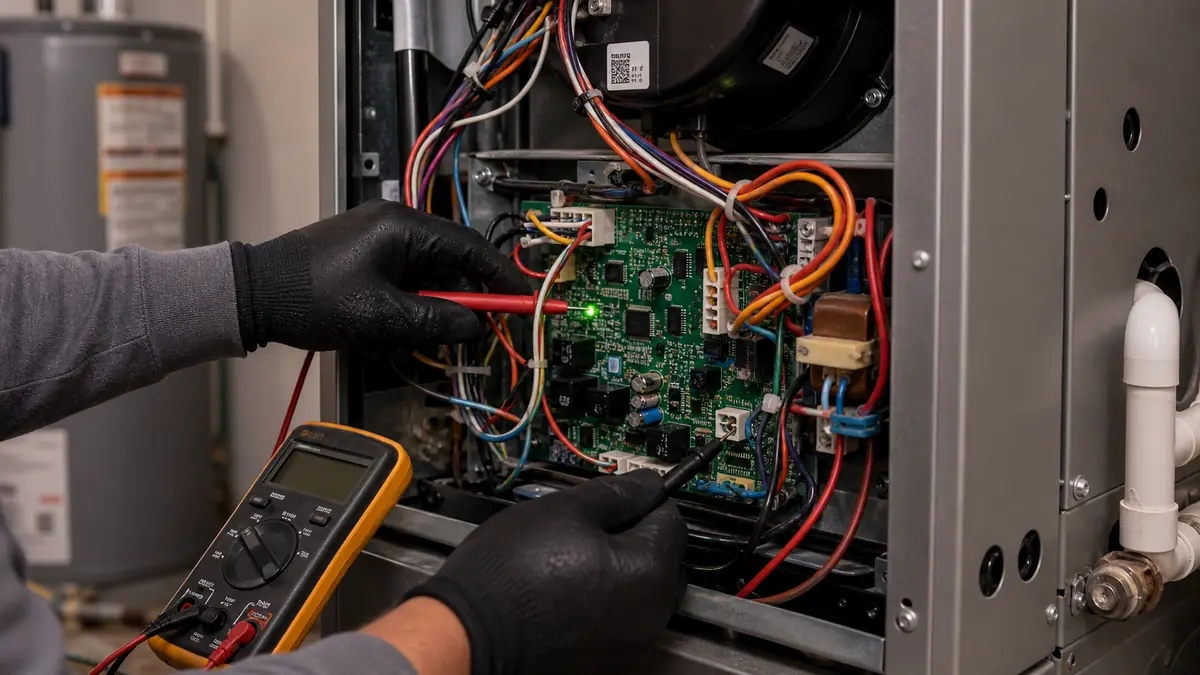
What does 3 flashes mean on a Trane furnace?
Three flashes on the Trane integrated furnace control is the pressure-switch / vent fault: the control asked the inducer to start, then looked for the pressure switch to close, and it did not see it close (or it opened mid-cycle). The pressure switch is a diaphragm that senses the negative pressure the inducer blower creates through a thin rubber hose. When the inducer pulls a clean draft, the diaphragm moves, the contacts close, and the control allows ignition. A 3-flash means that proof of draft never arrived, so the burners stay off. On a communicating XV system, the XL824 or XL850 surfaces the same condition as a plain-language venting or inducer alert rather than a blink.
What causes a Trane 3-flash in a Glendale home?
The fault is almost always in the draft path, not the switch. We see, in rough order: a blocked vent termination - leaves, a bird or wasp nest, or debris at a side-wall or rooftop cap, common on Glendale's older foothill homes; a weak or failing inducer motor that spins but cannot build rated pressure; a cracked, kinked, or disconnected sensing hose between the switch and the inducer housing; on 95-percent condensing furnaces, a plugged condensate trap or drain that backs water into the pressure path; and only then a genuinely failed pressure switch. Cold, dense Santa Ana-season air and rooftop terminations on hillside homes make Glendale venting faults a little more common in winter than the flatland average.
How do you diagnose a Trane pressure-switch fault, step by step?
We test the draft path with instruments rather than just swapping the switch.
- Read the code and confirm the sequence. We watch the inducer start and time when the control gives up looking for the switch.
- Inspect the vent. We check the termination and the full flue run for blockage, slope, and on condensing units the condensate trap and drain.
- Measure inducer draft. A manometer on the switch port tells us whether the inducer is actually making the pressure the switch needs; this separates a draft problem from a switch problem in one reading.
- Test the switch and tubing. With known draft present, we check the switch contacts and the sensing hose for cracks, water, or a loose fit.
- Confirm the inducer. If draft is low with a clear vent, we check the inducer motor amp draw and wheel; a tired inducer that cannot make rated pressure is replaced, then we re-prove the switch.
What can I safely check before calling about a 3-flash?
One homeowner check is safe and worth doing: look at the vent termination. From the ground, see whether the flue cap on the roof or the side wall is obstructed by a nest, leaves, or debris, and clear anything obvious you can reach safely. If you have a condensing furnace and you see water near the unit, a plugged condensate drain may be the cause. Beyond that, do not bridge or jumper the pressure switch to force the furnace to light - that bypasses the exact safety that keeps flue gases out of your home. If the termination looks clear, leave the system off and call us with the flash count.
When should a 3-flash be treated as urgent?
Treat it as urgent any time you cannot find and clear an obvious vent blockage, because a furnace that cannot prove draft should not be running, and forcing it risks venting combustion products indoors. If you have already cleared a visible obstruction and it still flashes 3, or if a carbon-monoxide alarm has sounded, shut it off and call. Our Trane fault-code guide walks the other furnace codes, and our emergency service page covers no-heat nights across Glendale.
Common questions
What is the pressure switch on a Trane furnace?
It is a small safety switch that confirms the inducer fan is pulling proper draft before the furnace lights. A rubber hose senses the negative pressure the inducer creates; if that pressure is present, the switch closes and ignition proceeds. If draft is weak or absent, the switch stays open, the furnace will not light, and the control flashes 3. It is preventing the burners from firing without a clear path for flue gases.
Can a blocked flue cause a Trane 3-flash?
Yes, and it is one of the first things we check. A blocked or restricted vent termination - a bird nest, a wasp nest, debris, or a screen iced or leaf-clogged - kills the draft the pressure switch needs, so the switch never closes and the furnace flashes 3. On Glendale rooftops and side-wall terminations we inspect the cap from the ground first, then at the unit. A condensing furnace can also flash 3 from a clogged condensate drain backing up into the trap.
Is a Trane 3-flash safe to keep resetting?
No. The 3-flash means the furnace cannot prove it is venting safely, so it is refusing to light on purpose. Repeatedly resetting it to force ignition defeats a safety that exists to keep flue gases - including carbon monoxide - out of your home. If a quick visual of the vent termination does not reveal an obvious blockage you can clear, leave it off and call. This is a code to respect, not to override.
How much does a Trane pressure-switch repair cost in Glendale?
It depends on what failed. Clearing a blocked flue or a plugged condensate drain is often inside a diagnostic visit, roughly $79 to $200 in Glendale. A failed inducer motor runs about $300 to $700 installed; a bad pressure switch itself is roughly $150 to $350; cracked or disconnected sensing tubing is minor. We confirm with a manometer on the inducer before quoting a part.