Trane Gas Furnaces in Glendale
Short version: Call Glendale Trane HVAC at (213) 772-2088 or book online to service or install a Trane gas furnace anywhere across Glendale, CA - from the modulating XC95m down to the value 80% AFUE S-series units in homes from Rossmoyne (91206) to El Miradero (91207). We read the integrated furnace control flash codes to diagnose lockouts; replacement typically runs $3,000 to $7,500.
The essentials
- Trane furnace lines: XC95m (~97.3% AFUE), XV95, S9V2 two-stage (~96%), 80% S-series.
- 80% AFUE (XR80/XL80/XV80) is common and often adequate in mild Zone 9 winters.
- Flash codes: 2 lockout, 3 pressure switch, 4 high-limit, 7 gas valve, 8 flame sense, 9 igniter.
- Common parts: hot-surface igniter, flame sensor, inducer, pressure switch, high-limit.
- Furnace replacement typically $3,000 to $7,500 (2026 SoCal); 80% lower, modulating higher.
- California Ultra-Low NOx furnace rules apply to new installs - we verify compliance.
- Cracked heat exchanger means replacement, not repair - a safety call.
What Trane furnaces fit a Glendale home?
Trane's gas furnace range runs from the flagship XC95m - a modulating gas valve with a variable-speed ECM blower, up to about 97.3% AFUE - down through the variable-speed XV95, the two-stage S9V2 (around 96%), and the budget 80% AFUE tier (XR80, XL80, XV80, XB80). In Glendale's mild Climate Zone 9, the 80% tier is frequently the practical choice: winters are short enough that the fuel savings from a condensing 95-plus model take many years to repay the price difference. Where comfort matters - a foothill home with rooms that swing temperature - a two-stage or modulating furnace delivers quieter, steadier heat. If your existing unit is already locking out, start with Trane furnace repair in Glendale before you price a replacement.
| Model | AFUE / burner | Best Glendale fit |
|---|---|---|
| XC95m | ~97.3%, modulating + variable ECM | Comfort-first home wanting the quietest, steadiest heat |
| XV95 | ~97%, variable-speed | High efficiency without full modulation |
| S9V2 | ~96%, two-stage + variable ECM | Value high-efficiency for a foothill home with temperature swings |
| S9X2 / XR95 | 95-96%, single/two-stage | Mid-tier replacement on a moderate budget |
| XR80 / XL80 / XV80 | 80%, single-stage | The common, practical pick for Glendale's short heating season |
How do you diagnose a furnace that won't heat?
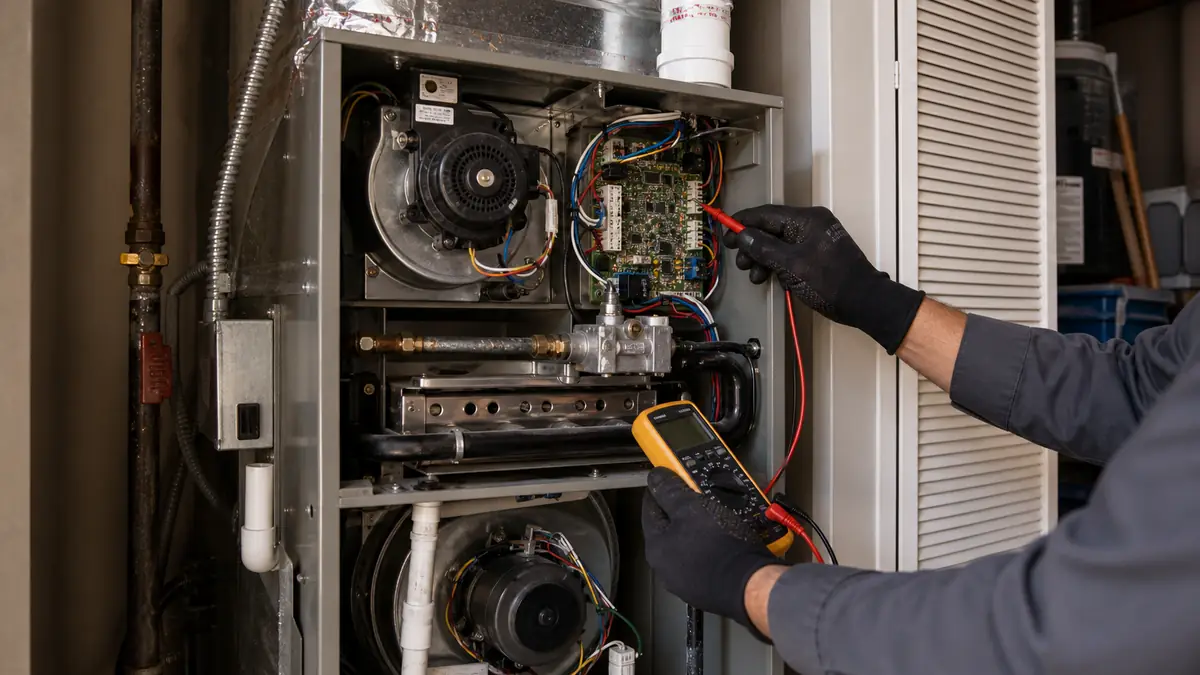
Trane furnaces report through a flash code on the integrated furnace control LED, so the diagnosis starts by reading the blink pattern. From there we test the indicated part. A 2-flash lockout points at the ignition train - hot-surface igniter or flame sensor. A 3-flash sends us to the pressure switch and inducer or a blocked flue. A 4-flash high-limit usually means restricted airflow. An 8-flash is a dirty flame sensor that needs cleaning, and a 9-flash is the igniter circuit. We confirm with a meter rather than throwing parts at the code; the step-by-step service flow is on our furnace repair page.
| Flash code | Meaning / first check | Typical cost lane |
|---|---|---|
| 2 flashes | System lockout (igniter/flame sensor) | $150 - $500 |
| 3 flashes | Pressure switch / inducer / blocked flue | $200 - $700 |
| 4 flashes | Open high-limit (low airflow, dirty filter) | $120 - $400 |
| 7 flashes | Gas valve circuit fault | $200 - $700 |
| 8 flashes | Low flame sense (clean flame sensor) | $120 - $300 |
| 9 flashes | Igniter circuit / grounding problem | $150 - $500 |
| 6 flashes | Polarity/ground; inspect for rollout | Diagnose on site |
What about California's furnace rules?
A new gas furnace in California has to meet Ultra-Low NOx emissions limits, so a replacement is not a like-for-like swap of the old model - we fit compliant equipment. Title-24 governs the installation as well, and SoCalGas has offered rebates on qualifying high-efficiency furnaces (commonly a minimum of 92% AFUE), though the amounts shift by program year and should be verified. If your furnace is near the end of its life, it pays to price a Trane heat pump conversion against a furnace replacement, since the local climate favors heat pumps - see our Trane heat pump page.
When is a furnace a safety problem, not a repair?
A cracked or rusted-through heat exchanger can leak carbon monoxide into your living space, and no repair makes that safe. If we find a compromised heat exchanger or a rollout condition, we shut the furnace down and recommend replacement. The same goes for a furnace that repeatedly trips its high-limit - the recurring overheating that causes those 4-flash codes is exactly what cracks heat exchangers over years. We diagnose the airflow cause instead of resetting the symptom.
Is a new furnace right for your home, or a heat pump?
Choose a Trane furnace replacement when you want to stay on gas, the existing flue and gas line are sound, and you prefer the simpler like-for-like swap - keeping in mind a new unit must meet California Ultra-Low NOx limits, so it is not identical to the old model. Choose an 80% AFUE tier over a condensing 95-plus model when the heating season is short enough that the efficiency premium will not repay quickly, which describes most Glendale homes. Lean toward a heat pump conversion when your furnace is at end of life, the panel has capacity, and you want one unit for heat and cooling with a shot at electrification rebates. We price both paths so the decision is grounded in your home's numbers.
Common questions
My Trane furnace won't light - what do the flash codes mean?
The integrated furnace control blinks a status LED. Two flashes is a system lockout (ignition retries exceeded), three flashes is a vent or pressure-switch error, four flashes is an open high-limit (often low airflow from a dirty filter), seven is a gas-valve circuit fault, eight is weak flame sense, and nine is an igniter circuit problem. We read the code, then test the matching part.
Do I need a 96% furnace in Glendale, or is 80% enough?
Glendale's mild Zone 9 winters mean an 80% AFUE furnace (XR80, XL80, XV80) is frequently adequate and common here - you simply do not run heat enough hours to recover the premium of a condensing model quickly. That said, a modulating XC95m or two-stage S9V2 gives quieter, steadier heat if you value comfort. We size and advise both ways.
Why does my furnace short-cycle or trip the limit?
A 4-flash high-limit trip usually means airflow is restricted - a clogged filter, a blocked return, or undersized 1920s ductwork choking the blower. The furnace overheats and shuts off on the safety limit. We measure static pressure and airflow rather than just resetting it, because repeated limit trips can crack a heat exchanger over time.
Is it safe to keep running an old furnace with a cracked heat exchanger?
No. A cracked heat exchanger can leak combustion gases including carbon monoxide into your home's air. A 6-flash rollout indication or visible cracking means we red-tag the furnace and recommend replacement. We never patch a compromised heat exchanger - safety is not a place to economize.
What's the difference between the XC95m, S9V2, and an 80% furnace?
Efficiency and how the burner runs. The XC95m modulates its gas valve and variable-speed ECM blower up to about 97.3% AFUE for the quietest, steadiest heat. The S9V2 is two-stage with a variable-speed ECM at around 96%. The 80% tier (XR80, XL80, XV80) is single-stage and the practical pick for Glendale's short heating season, where the fuel savings of a 95-plus model take many years to repay.
Should I replace my Glendale furnace or convert to a heat pump?
In Glendale it is worth pricing both. A mild Zone 9 winter is exactly where a heat pump shines - one outdoor unit heats and cools, with no flue or carbon-monoxide risk, and conversions may qualify for electrification rebates. If you prefer to stay on gas, a Trane furnace is the simpler swap. We quote a furnace replacement and a heat pump conversion side by side so the numbers, not a sales pitch, decide.
How long does a Trane furnace last in Glendale?
Because Glendale's heating season is short, furnaces here often outlast the national average - a well-maintained Trane commonly runs 18 to 25 years. The parts that wear are the hot-surface igniter, the flame sensor, and the inducer; those are routine repairs. The clock really runs out on the heat exchanger, which is a safety-driven replacement rather than a repair.