High HVAC Energy Bills in Glendale
Short version: Glendale Trane HVAC diagnoses high cooling bills across Glendale, CA (ZIP 91201-91208), so call (213) 772-2088 or book online to measure the real cause on your Trane system. The usual culprits are low refrigerant charge, dust-fouled coils, leaky 1920s ducts, an oversized unit short-cycling, or aging SEER.
The essentials
- Climate Zone 9 is cooling-dominant: long season, 35-50 days a year above 90 F.
- Low refrigerant charge (a leak) makes the system run longer for the same cooling.
- Dust-fouled Spine Fin and evaporator coils raise head pressure and run time.
- Leaky attic ducts in older homes can lose 20-30% of cooled air.
- Oversized units short-cycle - frequent starts, weak dehumidification, faster wear.
- Title-24 calls for HERS duct-leakage testing whenever ductwork is altered.
- A variable-speed XV20i (up to ~20.5 SEER2) modulates instead of cycling.
Why are my cooling bills climbing in Glendale?
In a cooling-dominant Climate Zone 9 city with a long summer and 35 to 50 days a year above 90 F, your air conditioner is your biggest seasonal load - so small inefficiencies show up fast on the bill. The common causes share a signature: the system runs longer for the same comfort. A slow refrigerant leak drops capacity, a coil fouled with fine Verdugo-foothill dust raises head pressure, leaky ducts waste cooled air into the attic, and an oversized unit short-cycles without ever settling into efficient operation. None of these necessarily stop the AC from "working," which is why the bill rises quietly.
| Cause | How we confirm it | Typical fix lane |
|---|---|---|
| Low refrigerant (slow leak) | Superheat / subcooling read | $225 - $1,500 |
| Dirty coil / filter | Head pressure, airflow, visual | $120 - $400 |
| Leaky ductwork | Static pressure, duct-leakage test | $1,900 - $6,000 (replace) |
| Oversized / short-cycling unit | Run-time and cycle observation | Right-size on replacement |
| Aging low-SEER system | Age, model, amp draw | $5,000 - $12,000 (replace) |
| Failing capacitor (high amps) | Capacitance + amp draw | $150 - $450 |
How do you find which cause it is?
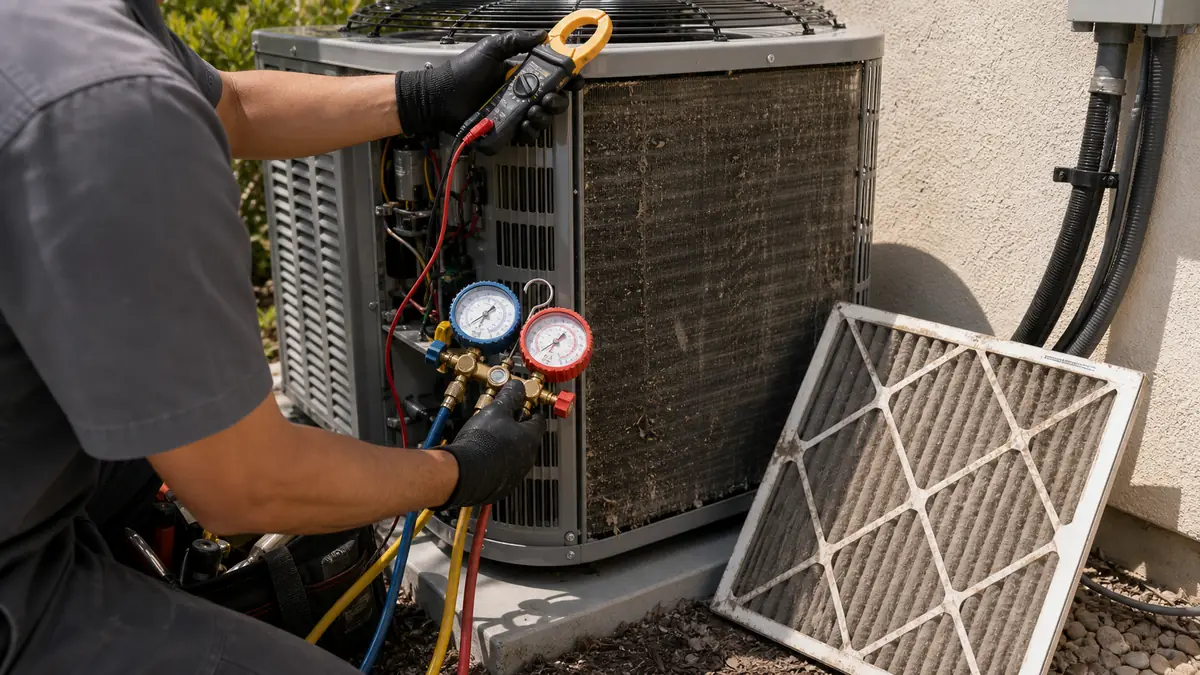
We measure rather than guess. Superheat and subcooling tell us whether the charge is correct; an out-of-spec reading points at a leak or a metering problem. Static pressure and an airflow read expose a dirty coil, a clogged filter, or undersized ducts. Compressor and fan amp draw reveal a unit working harder than it should - a weak capacitor, for instance, pushes amp draw up and quietly raises consumption. On a communicating XV system, the XL850 logs run-time data that helps separate a control/scheduling issue from a hardware one.
Does Glendale's housing stock matter here?
It is central. The 1910s-1930s flatland homes in Rossmoyne and Adams Hill were not built for ducted central air, so retrofitted ductwork in their attics is often leaky and undersized - one of the biggest hidden bill drivers in the city. Foothill homes in Glenoaks Canyon and El Miradero face longer run times because canyon pockets hold heat into the evening, so an inefficient system there racks up more hours. We tailor the diagnosis to your home's vintage and location instead of assuming every Glendale address loses energy the same way. Our Rossmoyne high-bill page drills into one neighborhood.
What can I check myself before calling?
A few homeowner checks can rule out the cheap causes and sometimes fix the bill outright. Pull and inspect the filter - a gray, clogged filter chokes airflow and raises run time, and replacing it is the single easiest win. Confirm every supply register is open and unblocked by furniture, and that the return is not covered. Walk to the outdoor condenser and clear leaves and Verdugo dust from around it, keeping two feet of clearance, then gently rinse the Spine Fin coil with a hose with the power off. Check that the thermostat schedule is not overcooling an empty house. What you should not do yourself is touch refrigerant, open electrical compartments, or judge charge - low refrigerant, a weak capacitor, and duct leakage all need a meter and gauges to confirm, which is the call-a-pro line. If the filter, registers, and coil are clean and the bill is still high, the cause is one of the measured faults and a diagnostic visit is the next step.
What gives the best return?
Order of impact usually runs: fix the charge and clean the coils (cheap, immediate), seal or replace bad ducts (larger, high-return), then consider a right-sized higher-SEER2 replacement if the unit is old. A variable-speed Trane XV18 or XV20i that modulates capacity uses less energy than an old single-stage unit cycling full-on - but only if the ducts and charge are sound. We sequence the work so you spend on the fixes that actually move the bill, and we cover efficiency rules and rebates on our SEER2 guide.
Common questions
Why did my Glendale cooling bill jump even though nothing broke?
Gradual failures rarely announce themselves. A slow refrigerant leak, a coil fouling with Verdugo dust, or a capacitor losing capacity all make the system run longer for the same cooling - so the bill climbs while the AC still 'works.' A diagnostic visit measures charge, airflow, and amp draw to find which one is costing you.
Does duct leakage really raise my bill that much?
In older Glendale homes, yes. Leaky 1920s attic ductwork can spill 20 to 30 percent of your cooled air into unconditioned space, so the system runs far longer to hold a setpoint. California Title-24 calls for HERS duct-leakage testing on duct alterations exactly because those losses run large. Sealing the ducts is frequently the highest-return fix.
Would a higher-SEER2 Trane actually lower my bills here?
It can, especially if you are replacing a 15-plus-year-old unit running at an old SEER rating during Glendale's long cooling season. A variable-speed XV system that modulates instead of cycling full-on uses less energy for the same comfort. But efficiency gains only materialize if the ducts and charge are right - a high-SEER2 unit on leaky ducts underperforms.
Is my thermostat or my equipment driving the cost?
Both can. A miscalibrated or poorly scheduled thermostat overcools an empty house; a communicating XL850 can schedule around your real occupancy. But if the equipment is short-cycling, low on charge, or pushing air through a dirty coil, no thermostat setting fixes that. We check both the control and the equipment.