Trane Furnace Flashing 4: Open High-Limit in Glendale
Short version: A Trane furnace flashing 4 in Glendale, CA (ZIP 91201-91208) is an open high-temperature limit - the furnace overheated and shut off on its safety, almost always from restricted airflow. Replace the filter first; if the 4-flash returns, call (213) 772-2088 or book online and we meter it.
The essentials
- 4 flashes on the Trane integrated furnace control = open high-temperature limit.
- Root cause is low airflow 9 times out of 10, not a gas-side fault.
- Usual suspects: clogged filter, blocked return, collapsed flex duct, dirty blower wheel, failed ECM/PSC blower.
- The lockout is protective - repeated overheating is what cracks a heat exchanger.
- Safe homeowner step: change the filter, clear the registers, cycle once.
- Airflow repair in Glendale runs about $150 to $600; a failed limit switch about $150 to $350 installed.
- On XV systems the XL824/XL850 shows the same fault in plain language.
What does 4 flashes mean on a Trane furnace?
Four flashes on the amber status LED of a Trane integrated furnace control (IFC) is the open high-temperature limit code: the air leaving the heat exchanger climbed past the limit switch setpoint, the switch opened, and the control shut the burners down to protect the furnace. It is a symptom, not the disease. The limit switch did its job; the question is why the plenum got that hot. On the S9V2, S9X2, and 80-percent XR/XL furnaces common in Glendale, that limit is a fixed-temperature disc on the heat-exchanger bulkhead. On a communicating XV system the same condition shows as a plain-language overheat or airflow alert on the ComfortLink II XL824 or XL850 instead of a blink.
Why is my Trane furnace overheating and flashing 4?
Heat builds past the limit when the blower cannot move enough air across the heat exchanger to carry it away. The temperature rise across the furnace - return-air temperature subtracted from supply-air temperature - is supposed to sit inside the rise range stamped on the rating plate, usually 35 to 65 F. When airflow drops, rise climbs, and the limit trips. In Glendale homes the order of likelihood is consistent: a clogged 1-inch filter someone forgot for a season; supply registers closed in unused rooms; a return grille blocked by a couch; a collapsed or crushed flex run in a 1950s Adams Hill attic; a blower wheel caked with dust so it moves a fraction of its rated CFM; or an ECM or PSC blower motor that is failing and spinning slow. Less often the limit switch itself has weakened and opens early, which reads identically until we meter the actual plenum temperature against the switch rating.
How do you diagnose a Trane 4-flash in Glendale, step by step?
We work airflow from the cheap end to the expensive end and show you the readings.
- Confirm the code and history. Read the flash count, then pull stored fault history from the IFC to see how often it has locked out and whether it pairs with an ignition fault.
- Inspect the obvious airflow path. Filter, return grille, supply registers, and the blower compartment door switch - a door left ajar after a filter change can mimic low airflow.
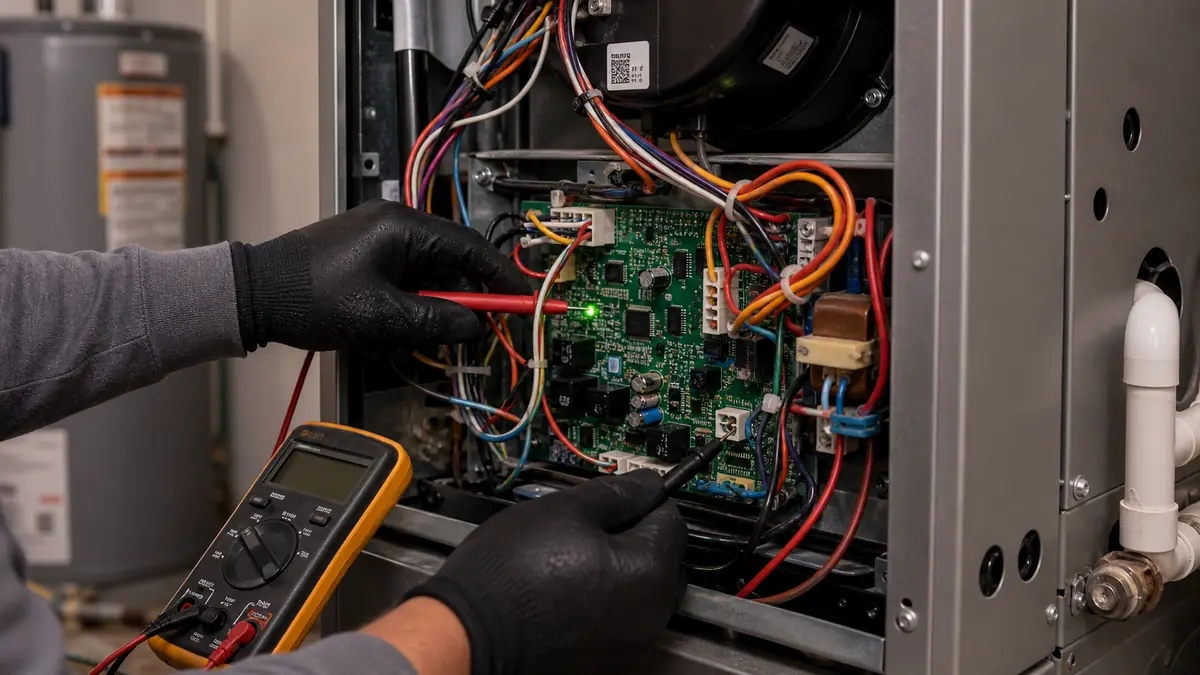
- Measure temperature rise. With the furnace running, we take supply and return temperatures and compare the rise to the rating-plate range. A rise of 80 F on a 35-to-65 furnace is a hard confirmation of low airflow.
- Read the blower. We check the blower wheel for dust loading and clamp the ECM or PSC motor amp draw against its nameplate; a slow, weak wheel and high rise together point at the motor or wheel, not the duct.
- Check the duct and the limit. If airflow is restricted with a clean filter and a good blower, we look at static pressure and the duct - crushed flex, undersized return, closed dampers. If airflow is actually fine and the limit still opens, we test the limit switch continuity against the measured plenum temperature and replace a failed switch.
What can I safely do before calling about a 4-flash?
There is one safe, useful homeowner step, and it fixes a large share of these calls. Turn the system off, replace the air filter with the correct size and a low-restriction pleated media (a too-dense "high-MERV" filter can itself starve a marginal blower), open every supply register, pull furniture off the return grille, and make sure the blower-compartment door is seated so its safety switch is closed. Then run one full heat cycle. If the furnace completes the cycle without flashing 4, the restriction was the filter or a register and you are done. If it locks out again, stop cycling it - repeatedly resetting a furnace that keeps overheating is exactly the pattern that fatigues a heat exchanger. Note the flash count and call us with it; that one number shortens the diagnosis.
When is a Trane 4-flash an emergency?
A single 4-flash that clears with a new filter is routine maintenance. It becomes urgent when it keeps returning after the filter is clean, because the underlying overheating is cumulative damage to the heat exchanger, and a cracked exchanger is a combustion-safety problem - it can let flue products into the supply air. If your furnace locks out on 4 repeatedly, if you smell anything odd, or if a carbon-monoxide alarm sounds, shut the system off and call. Our Trane fault-code guide covers the other furnace codes, and our emergency service page covers same-day situations across Glendale's 91201-91208 ZIPs.
Common questions
Is a Trane 4-flash code dangerous?
Not immediately, but a recurring 4-flash is the warning that does real damage if ignored. The code itself just means the furnace shut off on its high-limit safety, which is the system protecting itself. The danger is the repeated overheating behind it: each lockout-and-restart cycle heat-stresses the heat exchanger, and over a season that is what cracks it. Clear the airflow restriction and the risk goes away.
Can I clear a Trane 4-flash myself?
Often yes, if the cause is a clogged filter. Replace the filter, open every supply register, and confirm the return grille is not blocked by furniture; then cycle the furnace. If it runs a full heat cycle without flashing 4 again, the restriction was the filter. If it locks out a second time, stop resetting it - the restriction is deeper (a collapsed flex duct, an undersized return, or a dirty blower wheel) and needs a meter and a look at the airflow.
Why does my Trane furnace flash 4 only on the coldest Glendale mornings?
Because that is when the furnace runs longest and pulls the most air through a marginal duct system. On a 38F Glendale foothill morning the burners stay lit long enough for heat to build past the limit setpoint if airflow is even slightly low. The same furnace can run fine on a mild day with short cycles. Long-runtime lockouts almost always point at airflow, not the gas side.
What does it cost to fix a Trane 4-flash in Glendale?
A filter or register fix is essentially free. A real airflow repair runs about $150 to $600 in Glendale depending on cause - a blower-wheel cleaning, a failed ECM or PSC blower at the higher end, or duct repair. If the limit switch itself has failed open, the switch is roughly $150 to $350 installed. We quote after we meter temperature rise and airflow, not before.