Trane AC Repair in Glendale
Short version: Call Glendale Trane HVAC at (213) 772-2088 or book online for same-week Trane AC repair across Glendale, CA - from Adams Hill and Rossmoyne (91205, 91206) to Verdugo Woodlands (91208). We diagnose capacitors, contactors, refrigerant leaks, TXV faults, and Spine Fin coil problems on XR and XV systems; most repairs land in the $150 to $1,500 lane.
The essentials
- Most common Glendale AC failure: dual-run capacitor, driven by Zone 9 summer heat.
- Diagnostic visit typically $79 to $200 (2026 SoCal); credited toward approved repair.
- Capacitor or contactor replacement typically $150 to $450.
- Refrigerant leak repair plus recharge typically $225 to $1,500 (R-410A around $50-80/lb installed).
- Covers Trane XR13-XR17, XL16i/XL18i, XV18, and XV20i condensers.
- Same-visit electrical repairs; same-week scheduling in 91201-91208.
- In-warranty compressor or coil referred to a Trane-authorized dealer first.
What usually breaks on a Trane AC in Glendale?
In a Climate Zone 9 city that logs 35 to 50 days a year above 90 F, the failures cluster around heat stress on electrical parts. The dual-run capacitor tops the list - it bulges or drops capacitance and the condenser hums without starting. The contactor is second: its points pit and weld from thousands of start cycles. After that come refrigerant leaks (often at a service valve or a rubbed line), a clogged or failed TXV starving the coil, and ECM or PSC blower faults that kill airflow. On communicating XV systems, the XL824 or XL850 thermostat shows a plain-language alert; on non-communicating XR and XL units there is no numeric code, so we diagnose electrically with a meter.
How does a Glendale AC repair actually go, step by step?
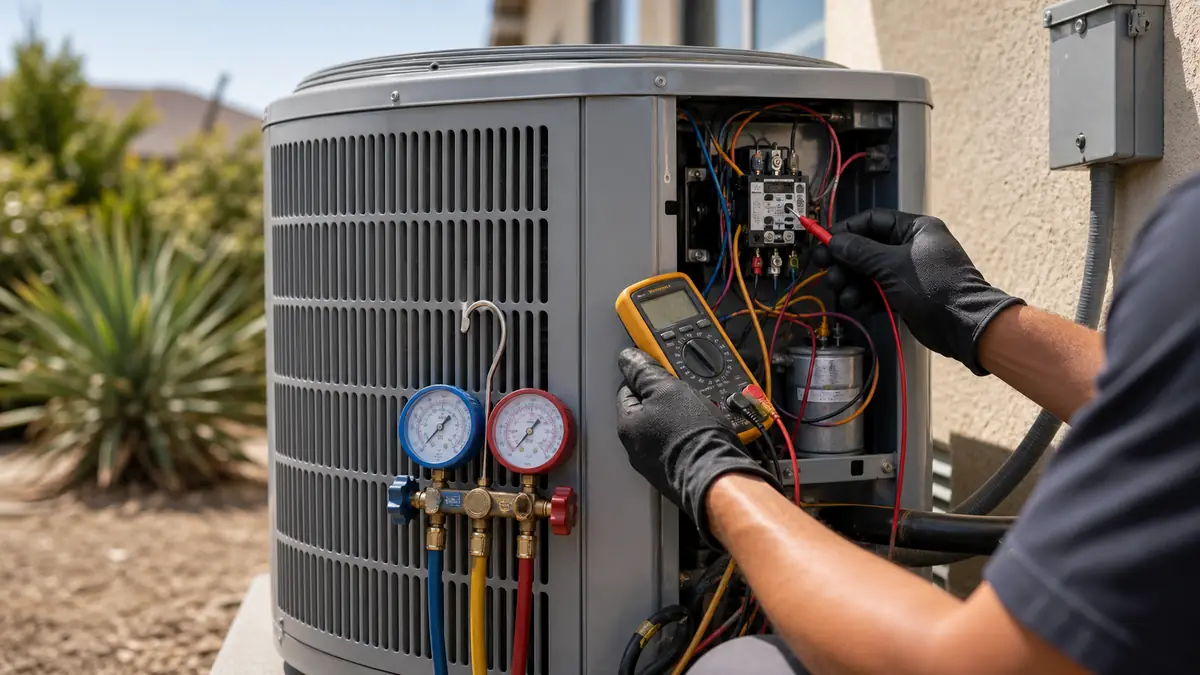
We work the system in a fixed order rather than guessing, and we show you the readings as we go.
- Confirm the call. Verify the thermostat is calling for cool and that 24V reaches the contactor coil at the Y terminal - a dead 24V signal points upstream to a tripped float switch, blown low-voltage fuse, or transformer.
- Read the electricals. Meter capacitance on the dual-run capacitor against the microfarad rating printed on its label, inspect the contactor points for pitting or welding, and clamp compressor and condenser-fan amp draw against the nameplate RLA and FLA.
- Check the refrigerant circuit. If the electricals are sound, connect gauges and take superheat and subcooling. Low subcooling with high superheat reads as undercharge from a leak; a flooded reading points at a stuck TXV.
- Find the leak. When the charge is low we search with an electronic detector and bubble solution at service valves, the Spine Fin coil, and the line set - flatland side yards in Rossmoyne hide a lot of rubbed-through suction lines.
- Repair and verify. After the fix we pull a vacuum on any opened circuit, weigh in the correct R-410A charge, then re-check superheat, subcooling, supply-air split, and amp draw before we call it done.
How do you diagnose a no-cool call?
The order above flows from the cheapest, most common failure to the most involved. On communicating XV systems the XL824 or XL850 thermostat hands us a plain-language alert that narrows the search before we arrive; on non-communicating XR and XL units there is no screen code, so the meter does the talking. A furnace or air handler that trips its high-limit on low airflow throws a 4-flash code on the integrated furnace control - a classic symptom in dust-loaded Glendale returns, and one we trace to airflow rather than refrigerant.
| Symptom | Likely cause / first check | Typical cost lane |
|---|---|---|
| Condenser hums, won't start | Dual-run capacitor; then contactor | $150 - $450 |
| Outdoor unit dead, no hum | Contactor, breaker, or 24V control fault | $150 - $450 |
| Runs but weak cooling, ice on coil | Low refrigerant (leak), dirty coil, or TXV | $225 - $1,500 |
| Water at the air handler, unit shuts off | Clogged condensate drain, open float switch | $150 - $600 |
| Blower won't move air | ECM/PSC blower motor or module | $450 - $2,300 |
| XV system, "loss of communication" alert | ComfortLink II wiring or inverter board | $400 - $2,000 |
| Compressor failed, unit 12+ yrs | Repair vs replace - see install page | $1,200 - $3,500 (or replace) |
Which Trane AC lines do you repair?
We cover the full residential range, and the line changes how we diagnose:
- XR single-stage (XR13, XR14, XR15, XR16, XR16 Low Profile, XR17). The value workhorse - non-communicating 24V, so every diagnosis is electrical with a meter. The Climatuff compressor either runs or it does not; the capacitor is the usual culprit.
- XL two-stage (XL16i, XL18i). Communicating-capable two-stage Climatuff. Faults split between ordinary electrical failures and staging or control issues.
- XV18 (4TTV8 / 5TTV8) and XV20i (4TTV0 / 5TTV0). Variable-speed Climatuff with all-aluminum Spine Fin and ComfortLink II. These surface plain-language alerts on the XL824/XL850, and a comm-bus or inverter-board fault is a distinct repair class from a capacitor.
If your condenser model starts 4TTV0 or 5TTV0 you have an XV20i; a label starting 4TTR is an XR-family workhorse. Knowing the family before we arrive lets us load the right parts.
What does an AC repair cost in Glendale, broken down?
Most Glendale repairs fall in a predictable band once the diagnosis is in. The diagnostic visit runs $79 to $200 (often credited toward the repair). A dual-run capacitor or contactor lands at $150 to $450 - the part is cheap and most of the cost is the trip and labor. A refrigerant leak repair plus recharge runs $225 to $1,500, driven by how hard the leak is to find and how much R-410A (about $50 to $80 a pound installed) the system takes. An ECM blower motor or module is $450 to $2,300, with variable-speed modules at the top. A ComfortLink II or inverter board on an XV system is $400 to $2,000. A compressor is $1,200 to $3,500 - the number that usually tips a 12-plus-year unit toward replacement.
Repair or replace - where's the line for a Glendale home?
Two rules of thumb settle it. First, when a repair runs more than roughly half the price of a new system and the unit is older than 10 to 12 years, replacement usually wins. Second, the age-times-repair-cost test: multiply the unit's age in years by the repair quote, and if it tops about $5,000, lean toward replacing. A capacitor on a 16-year-old XR16 clears that easily; a $2,800 compressor on the same unit fails both tests. We work the numbers with you, and if they point to replacement, we show Trane options sized to your home on our AC installation page.
Does Glendale's housing stock change the repair?
It does. In Rossmoyne and Adams Hill, 1920s Spanish Colonial revival homes often run a condenser tucked into a side yard with restricted airflow and original ducts that leak - so a "weak cooling" complaint is sometimes a duct problem, not a refrigerant one. In Glenoaks Canyon and El Miradero, foothill heat means longer run times and harder-worked compressors, so we pay extra attention to capacitor health and contactor wear there. We bring this context to the diagnosis instead of treating every Glendale address the same.
What about the Trane warranty?
If your compressor or coil is inside Trane's registered parts warranty (commonly 10 years on residential systems), start with a Trane-authorized dealer so the part is covered. We will say so plainly. For everything else - out-of-warranty repair, labor-only when you source a warranty part, or a second opinion on someone else's quote - that is exactly the work we do. Read our independence statement on the about page.
Common questions
Why does my Trane condenser hum but the fan won't spin in the heat?
Almost always a failed dual-run capacitor - the single most common AC failure in Glendale's summer heat. The capacitor gives the fan and compressor motors their starting torque. We test capacitance against the microfarad rating on the label and replace it; in the same visit we check the contactor, which pits and welds from the same heat cycles.
Is it worth repairing a 16-year-old Trane AC in Adams Hill?
Use the repair-versus-replace math: if the repair costs more than about half a new system and the unit is past 12 years, replacement usually wins. A $300 capacitor on a sound 16-year-old XR is worth doing; a $2,500 compressor on the same unit is not. We give you both numbers before you decide.
How long does an AC repair in Glendale usually take?
Electrical repairs - capacitor, contactor, fan motor - are typically same-visit, often under two hours. Refrigerant leak repair takes longer because we have to find the leak, fix it, pull a vacuum, and weigh in the correct R-410A charge. We confirm the timeline once we diagnose on site.
Do you repair the Trane Spine Fin coil or just replace it?
Depends on the damage. Trane's all-aluminum Spine Fin coil resists corrosion and has fewer joints to leak, but a hail dent or a rubbed-through line is sometimes spot-repairable. A leaking or badly fouled coil usually gets replaced; we weigh repair cost against the unit's age and remaining warranty.
My XV20i shows 'loss of communication with outdoor unit' - is that a big repair?
Not always. That ComfortLink II alert means the 4-wire bus between the XL850 thermostat and the 4TWV0 outdoor unit dropped - often a loose or corroded conductor or lost 230V line voltage, which is an inexpensive fix. If the communicating or inverter board itself failed, the part runs $400 to $2,000. We trace the bus and meter line voltage before condemning a board.
Can a dirty filter really stop my Trane AC in Glendale?
Yes. A choked filter or undersized 1920s return starves airflow across the evaporator, which can freeze the coil into a block of ice and, on the furnace side, trip the high-limit (a 4-flash code on the integrated furnace control). The system looks dead but the fix is airflow, not refrigerant. We measure static pressure to tell the difference instead of guessing.
Do you guarantee the AC repair?
Yes - a capacitor or contactor swap is a permanent fix, not a band-aid, and we stand behind the parts and labor we install. We quote the repair before doing it and you approve the price first. If a follow-up symptom traces to the same part we replaced, we make it right; if the diagnosis points to an end-of-life system, we say so rather than selling repeat repairs.